Acupuncture & Traditional Chinese Medicine in Manhattan's Flatiron District
Real needles, real relief — and gentler than almost everyone expects.
The Two Questions Every First-Timer Asks
Let's answer them before anything else.
Does it hurt? Acupuncture needles are about the width of a human hair — nothing like the needles used for injections or blood draws. They're sterile, single-use, and inserted with precision. Most people feel a mild heaviness, warmth, or tingling at the needle site. A significant number fall asleep on the table.
Is it safe? Acupuncture has been practiced for thousands of years and is recognized by the World Health Organization as an evidence-supported intervention for a wide range of conditions. In a licensed clinical setting with sterile technique, it carries an exceptionally low risk profile. I'm New York State licensed, board certified, and trained at the graduate level — this is not a wellness amenity, it's a clinical practice.
How Acupuncture Works — In Two Languages
Traditional Chinese Medicine describes health as the unobstructed flow of qi (vital energy) and blood through a network of pathways called meridians. When that flow is disrupted — by injury, stress, hormonal shifts, or chronic tension — pain and dysfunction follow. Acupuncture restores balance by stimulating specific points along those pathways, bringing the body back toward its own equilibrium.
Modern physiology offers a complementary explanation. Needle insertion at precise anatomical locations activates the nervous system, prompting the release of endorphins and other naturally occurring pain-modulating compounds. It down-regulates the sympathetic "fight or flight" response, improves local circulation, and reduces inflammation. The two frameworks describe the same phenomenon from different vantage points — and both have something real to say about why people feel better after a session.
I spent a decade in hospital healthcare marketing at institutions including NewYork-Presbyterian and Columbia before training in Chinese medicine. I understand how referring physicians think, and I explain what I do in language that works for both a skeptical MD and a patient who's never tried acupuncture before.
Electro-Acupuncture: Deeper Stimulation When It's Warranted
Electro-acupuncture uses the same fine needles as traditional acupuncture, with a small, gentle electrical current passed between pairs of points. The stimulation is mild and adjustable — most people describe it as a light pulsing sensation. It's particularly effective for musculoskeletal pain, nerve-related conditions, and cases where stronger or more sustained stimulation is clinically appropriate. I use it as an extension of standard treatment when the presentation calls for it.
What a Session Looks Like
A first appointment begins with a thorough intake — your health history, current concerns, sleep, digestion, stress, and any relevant medical background. I look at your tongue and feel your pulse, both of which are diagnostic tools in TCM. Then we talk about what you're hoping to address and I develop a treatment plan.
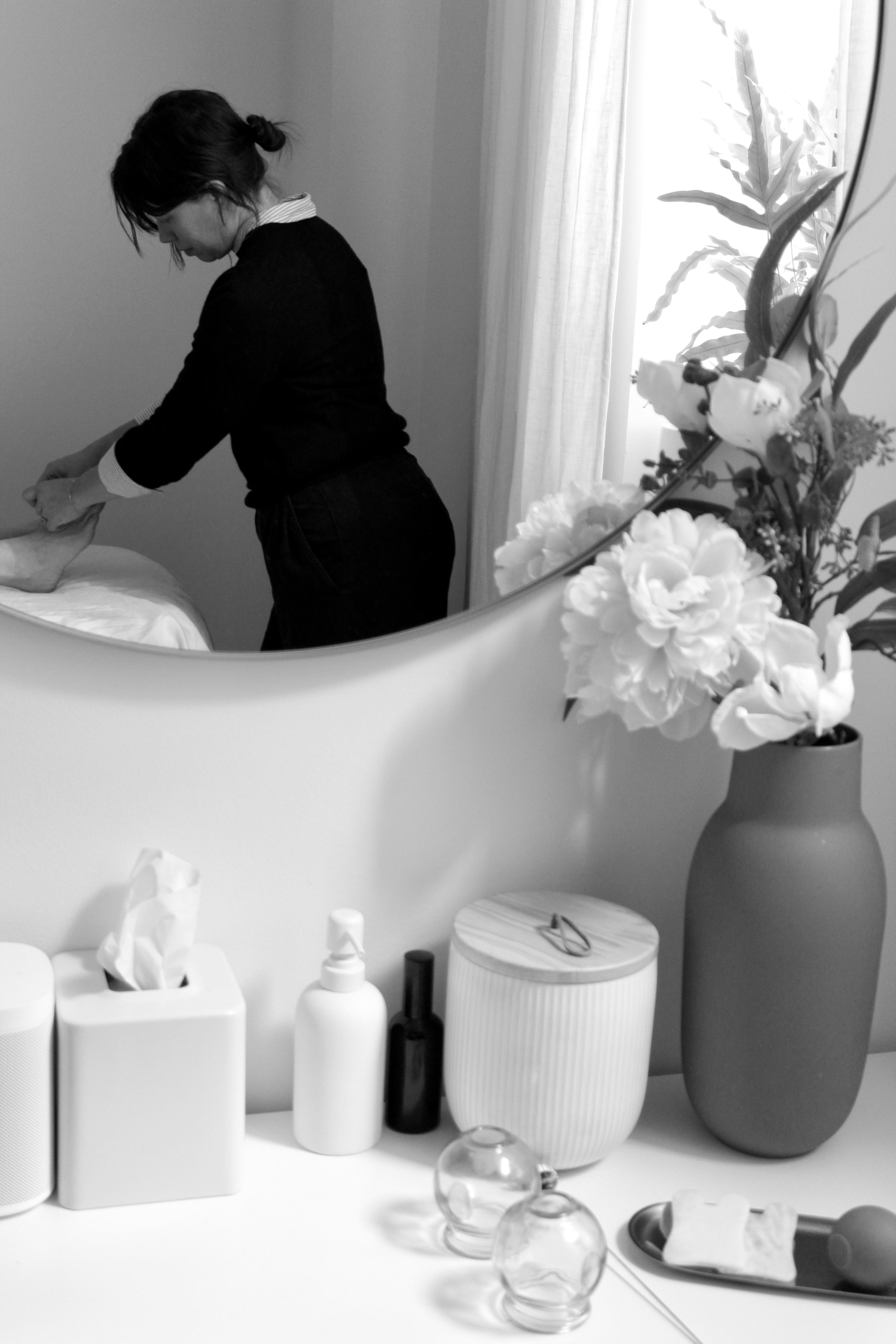
During treatment, you lie comfortably on a table while fine needles are placed at points relevant to your pattern. Most people enter a state of deep relaxation within minutes.
Depending on what your body needs, I may incorporate complementary modalities — cupping, gua sha, auricular acupuncture, ear seeds, moxibustion, or heat therapy. These are included in standard sessions at no additional charge.
What Acupuncture Is Commonly Used to Address
Acupuncture is a whole-system medicine, which means it works across a wide range of conditions rather than targeting a single symptom. The areas I treat most frequently include:
- Musculoskeletal pain: back pain, sciatica, neck tension, joint pain, sports injuries, and TMJ
- Women's health: menstrual irregularity and pain, PMOS (formerly PCOS), endometriosis, fertility support, IVF adjunct care, pregnancy discomfort, postpartum recovery, perimenopause, and menopause.
- Nervous system regulation: stress, anxiety, and insomnia
- Headaches and migraines
- Digestive issues: bloating, IBS, nausea, and irregular motility
If you've been referred by a physician or OB/GYN, I'm familiar with working alongside medical care — acupuncture complements your existing treatment, it doesn't compete with it.
Learn more about the conditions I treat through the links below, or book a session to discuss your specific situation.

Frequently Asked Questions
Every session is with me — not a rotating associate, not a student, not whoever is available that day. You see the same practitioner every time, which means your treatment evolves based on what I've observed across your full history with me.
I hold a Master's degree from Pacific College of Health & Science, one of the most rigorous TCM programs in the country. I’m also a board-certified Diplomate of Acupuncture by the NCBAHM. I'm also a DONA-trained postpartum doula, a Carriage House Birth-trained birth doula, and was a Certified Lactation Counselor — a combination that gives my women's health work a unique depth.
My office is at 928 Broadway, Suite 604, between 21st and 22nd Streets in the Flatiron District — a real neighborhood practice, not a borrowed address.
How many sessions will I need before I notice a difference?
It depends on how long you've been dealing with the condition and how your body responds. Acute issues — a recent injury, a tension headache — often respond within one to three sessions. Chronic conditions typically require a course of treatment, often six to ten sessions, before lasting change takes hold. I'll give you an honest sense of what to expect after your first appointment.Can I get acupuncture if I'm pregnant?
Yes, and it's one of the most common reasons patients come to see me. Acupuncture is used throughout pregnancy to address nausea, back and pelvic pain, fatigue, breech positioning, and labor preparation. I have advanced training in perinatal care and work closely with OB/GYNs and midwives. Certain points are avoided during pregnancy — which is exactly why you want a practitioner with specific training in this area.Does acupuncture work alongside conventional medical treatment?
It does, and that's often how I use it. Many of my patients are also seeing MDs, specialists, or fertility clinics. Acupuncture can support the effectiveness of other treatments, help manage side effects, and address symptoms that aren't fully resolved by conventional care alone. I receive referrals from physicians and OB/GYNs, and I'm comfortable communicating with your medical team when that's useful.What is electro-acupuncture and is it painful?
Electro-acupuncture involves a gentle electrical current passed between needles that are already in place. The sensation is a mild, rhythmic pulse — not a shock. The intensity is always adjusted to your comfort level. It's particularly well-suited for pain conditions and cases where sustained stimulation produces better results than needles alone.Do I need a referral to book an appointment?
No referral is required. You're welcome to book directly through my online scheduling system. That said, if your physician or OB/GYN has referred you, I'm glad to coordinate with them and appreciate the introduction.Is acupuncture covered by insurance?
Some insurance plans cover acupuncture, particularly for pain-related conditions. Coverage varies widely by plan. I recommend contacting your insurer directly to ask about your out-of-network benefits. I can provide a superbill — an itemized receipt — that you can submit for potential reimbursement.
My practice is located at 928 Broadway, Suite 604 — in the heart of the Flatiron District, between 21st and 22nd Streets. I see patients from across Manhattan, including Gramercy, Union Square, Chelsea, and NoMad, as well as people who travel in from Brooklyn, Long Island City, and northern New Jersey.